
- English
- Español
- Português
- русский
- Français
- 日本語
- Deutsch
- tiếng Việt
- Italiano
- Nederlands
- ภาษาไทย
- Polski
- 한국어
- Svenska
- magyar
- Malay
- বাংলা ভাষার
- Dansk
- Suomi
- हिन्दी
- Pilipino
- Türkçe
- Gaeilge
- العربية
- Indonesia
- Norsk
- تمل
- český
- ελληνικά
- український
- Javanese
- فارسی
- தமிழ்
- తెలుగు
- नेपाली
- Burmese
- български
- ລາວ
- Latine
- Қазақша
- Euskal
- Azərbaycan
- Slovenský jazyk
- Македонски
- Lietuvos
- Eesti Keel
- Română
- Slovenski
- मराठी
- Srpski језик

Why Is Color-blocked Car Seat Belt Webbing Becoming the New Standard in Automotive Safety?
Color-blocked car seat belt webbing has rapidly gained attention in the automotive industry due to its enhanced visibility, design flexibility, and improved user experience. As vehicle manufacturers increasingly focus on both safety and aesthetics, this innovative webbing style offers a balanced solution customers value. In my experience working with automotive safety materials, I have seen how color-blocked designs help brands distinguish their models, strengthen safety reminders, and elevate cabin interior appeal—all while preserving the durability expected from high-quality seat belt webbing.
Below is a complete professional breakdown of its performance, parameters, and applications.
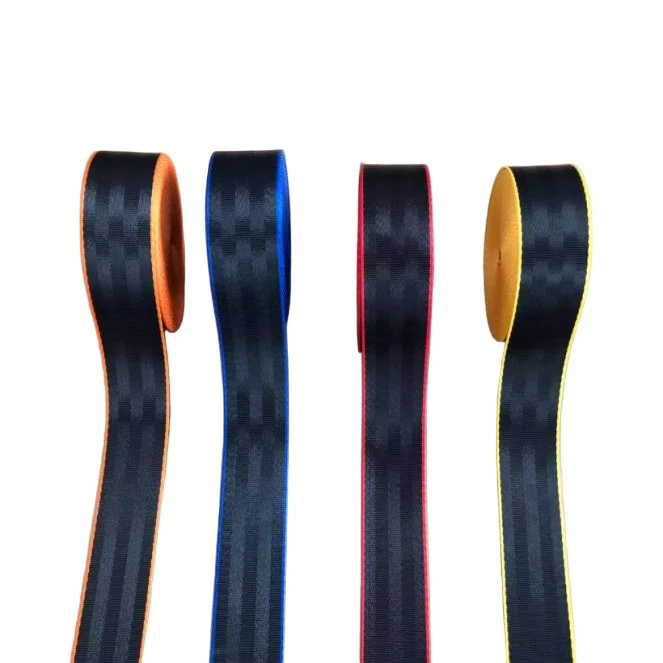
What Makes Color-blocked Car Seat Belt Webbing Different?
Color-blocked webbing is manufactured by weaving fibers into predetermined color sections, creating a stylish contrast that enhances both visibility and aesthetic value. Unlike traditional monochrome straps, color-blocked designs provide:
-
Clearer differentiation between seat belt orientations
-
Enhanced visibility at night or in low-light environments
-
Stronger interior design identity
-
Better passenger engagement and safety compliance
This type of webbing is particularly popular among electric vehicle brands, luxury car manufacturers, and custom car modification industries seeking distinctive interior elements.
How Do the Technical Parameters Ensure Safety and Performance?
The following parameters reflect the standard specifications offered by Baitengxin Webbing Industry (Jiangsu) Co., Ltd., which focuses on high-strength and visually appealing automotive webbing solutions.
Product Parameters Overview
| Parameter | Specification |
|---|---|
| Material | High-tenacity polyester yarn |
| Width | 46–49 mm (customizable) |
| Thickness | 1.1–1.3 mm |
| Tensile Strength | ≥ 28 kN |
| Color Style | Color-blocked / dual-tone / multi-zone |
| Colorfastness | Grade 4–5 (ISO standard) |
| UV Resistance | High resistance, automotive-grade |
| Abrasion Resistance | ≥ 5000 cycles |
| Certification | E-Mark, CCC, ISO 9001 |
| Application | Passenger cars, trucks, RVs, special vehicles |
Why Does the Performance of Color-blocked Car Seat Belt Webbing Matter?
From a technical point of view, seat belt webbing must withstand enormous tensile loads during sudden deceleration or collision. The color-blocked design has no impact on the structural strength—the webbing is woven as a single integrated piece, not stitched from multiple sections. Therefore, safety remains uncompromised.
Key Performance Advantages
-
Enhanced Identification
Color segmentation allows users to quickly identify belt direction, reducing incorrect usage. -
Greater Visual Appeal
Multi-color combinations significantly improve the interior style of mid- to high-end vehicles. -
Improved Passenger Compliance
Higher visibility encourages passengers—especially children and elderly users—to buckle up more consistently. -
Stable Mechanical Strength
Maintains high tensile strength, elasticity control, and abrasion performance. -
Flexible Customization
Branding colors, gradient patterns, or special contrast designs can be produced.
How Does Color-blocked Car Seat Belt Webbing Improve Actual Use Effects?
Color-blocked webbing demonstrates excellent results in real-world application:
-
Better nighttime visual guidance makes it easier to locate and adjust the belt.
-
Stronger brand recognition when used with unique color combinations.
-
More user-friendly experience, as the contrasting colors give intuitive orientation cues.
-
Higher perceived quality in upgraded vehicle interiors.
Automakers frequently report that using this type of webbing positively influences customer satisfaction and interior design ratings.
Why Is Color-blocked Car Seat Belt Webbing Important for Modern Vehicles?
As car interiors evolve from purely functional to comfort-oriented spaces, small components like seat belt webbing now play a larger role in design value. Furthermore, global safety awareness has increased, and visible safety equipment reinforces the importance of belt usage.
Its Importance Can Be Summarized as:
-
Safety enhancement
-
Design differentiation
-
Compliance improvement
-
Brand personalization
-
Long-term durability and reliability
For manufacturers seeking to elevate both safety perception and interior aesthetics, this type of webbing is becoming a key standard.
Frequently Asked Questions About Color-blocked Car Seat Belt Webbing
1. What is Color-blocked Car Seat Belt Webbing?
Color-blocked car seat belt webbing is a type of automotive webbing featuring two or more contrasting color sections woven directly into the strap. This design improves belt visibility, interior aesthetics, and user recognition while maintaining full tensile strength required for vehicle safety standards.
2. Is Color-blocked Car Seat Belt Webbing as strong as standard seat belt webbing?
Yes. The color-blocked pattern is woven, not stitched, ensuring structural integrity remains intact. It meets the same regulatory requirements—including tensile strength, abrasion resistance, melting point, and UV aging—as traditional seat belt webbing.
3. What types of vehicles commonly use Color-blocked Car Seat Belt Webbing?
It is widely used in passenger cars, SUVs, EVs, luxury vehicles, RVs, and modified cars. Many manufacturers choose it to highlight model features or emphasize safety with high-visibility designs.
4. Can the colors be customized according to brand needs?
Absolutely. Customization is one of the major advantages. Companies like Baitengxin Webbing Industry (Jiangsu) Co., Ltd. offer custom color palettes, contrast patterns, gradients, and branded styles to align with customer design themes.
Conclusion & Contact Information
Color-blocked car seat belt webbing has become a defining upgrade in modern automotive design—combining safety, durability, and visually appealing aesthetics. It provides manufacturers with versatile customization options while giving passengers a more intuitive safety experience.
If you are looking for a reliable supplier specializing in high-quality Color-blocked Car Seat Belt Webbing, feel free to contact Baitengxin Webbing Industry (Jiangsu) Co., Ltd. for professional support, product customization, and technical solutions tailored to your automotive projects.